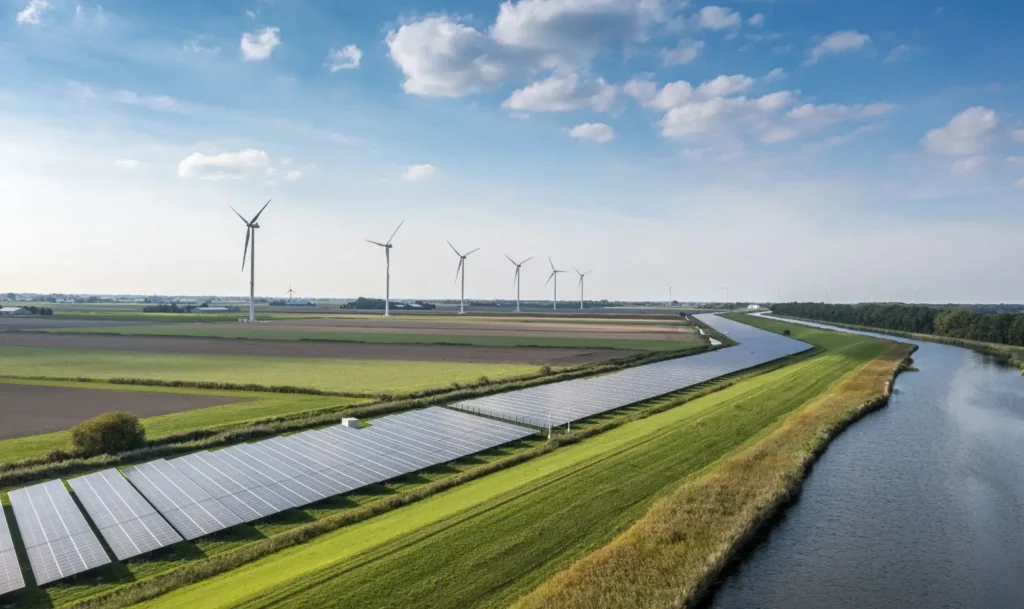
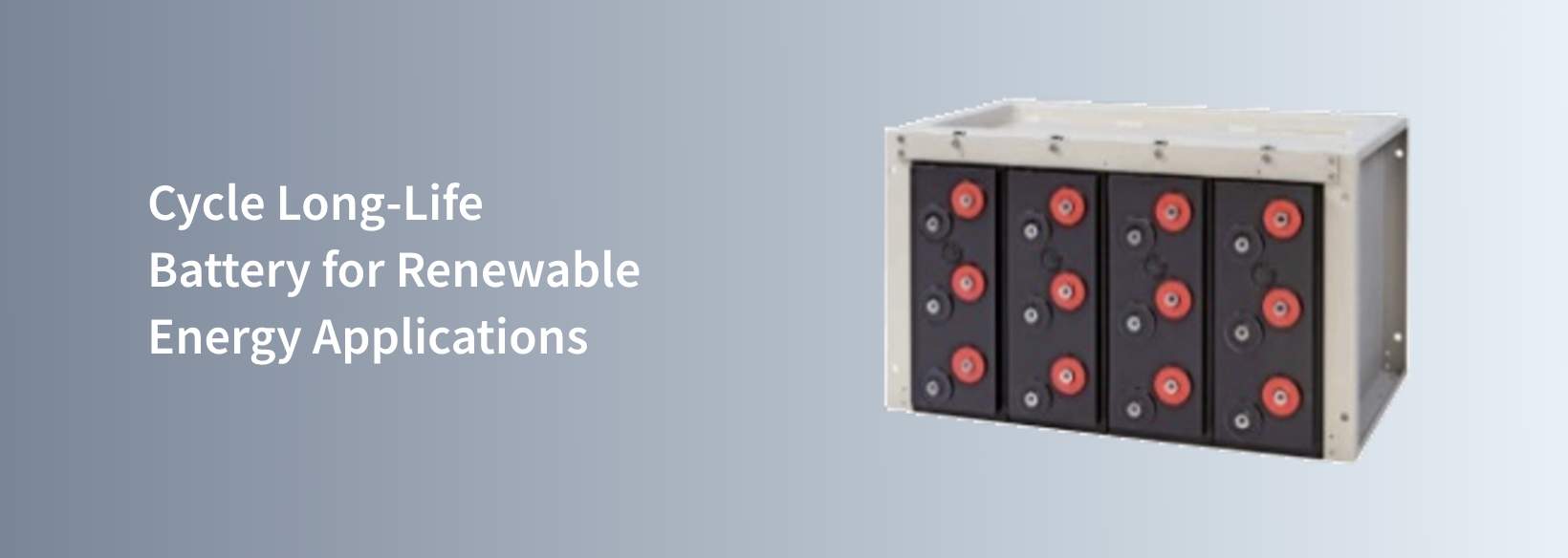
Cycle Long-Life Battery for Renewable Energy Applications Tuflong LL Series
Storage batteries that contribute to the optimal operation of renewable energy systems.
These batteries support the efficient utilization of renewable energy in pursuit of carbon neutrality.
In addition to self-consumption applications for power consumers, they can also be used for power utility applications such as supply–demand balancing, capacity markets, and wholesale electricity trading markets.
Main Applications
Solar power systems, wind power generation, other renewable energy generation with storage, energy storage facilities, on-site self-consumption (peak cut / peak shift), PPA, microgrids, Virtual Power Plants (VPP), smart grids
Features
High Safety with Low Fire Risk
Safe design with minimal risk of ignition
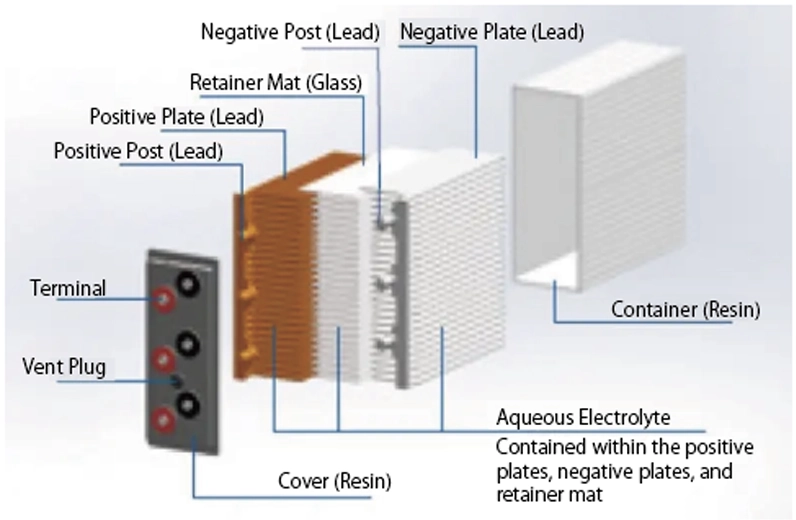
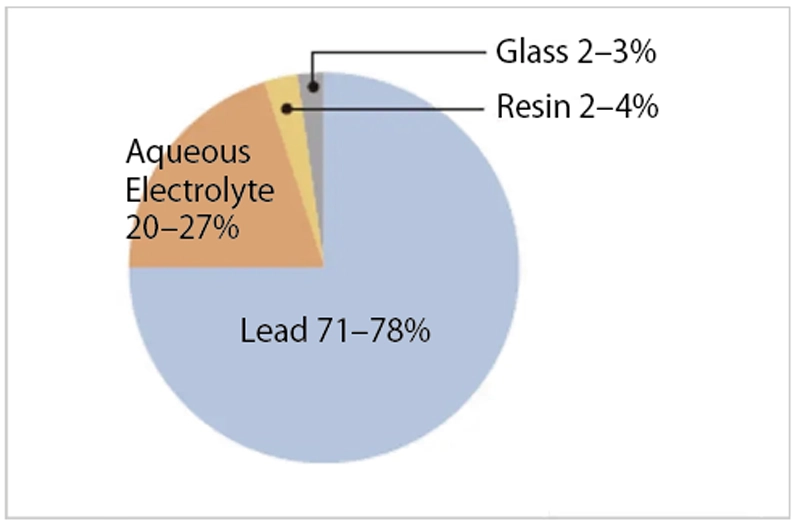
LL batteries are physically lead-acid batteries and are made from materials that do not qualify as hazardous substances.
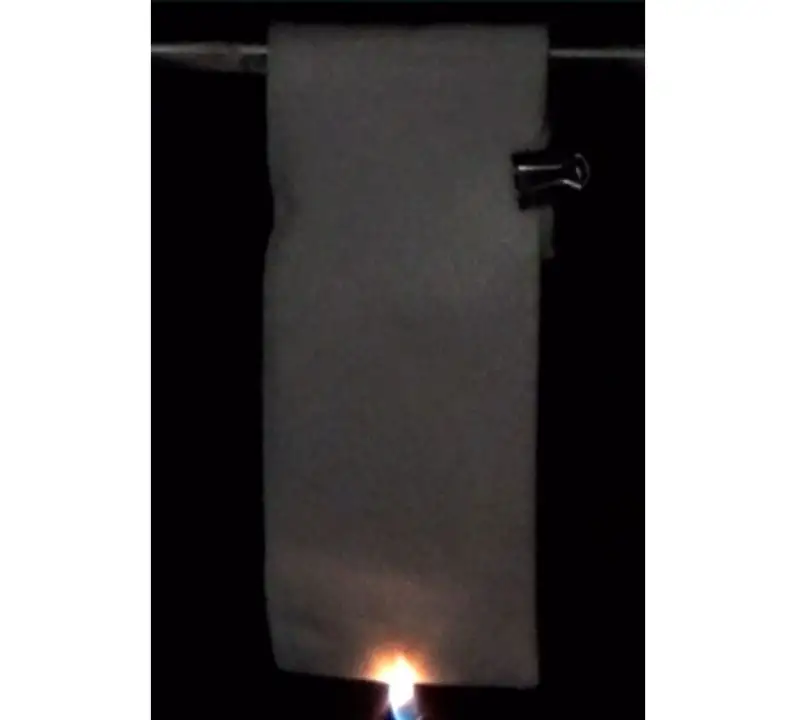
The electrolyte in Tuflong LL is water-based, and as shown in the photo (experiment bringing fire near a water-based electrolyte), it has the characteristic of being difficult to ignite even when exposed to fire. Physically, they are lead-acid batteries, do not use combustible materials, and are composed of materials that do not qualify as dangerous goods under the Fire Service Act. Therefore, the risk of ignition, combustion, or spreading fire is extremely low, allowing for safe installation even in densely populated residential areas, indoors, or underground.
Energywith’s lead-acid batteries are adopted for applications requiring stringent standards, such as nuclear power plants, due to their high safety and reliability.
See installation examples that leverage high safety
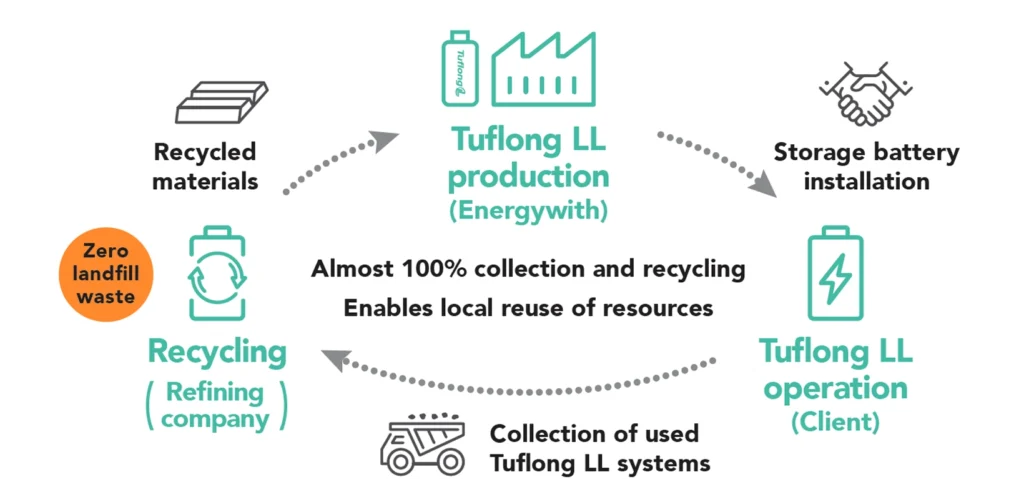
Nearly 100% recyclable
- Recycling is well-established, and CO2 reduction by recycling is expected. Additionally, it has low CO2 emissions throughout its lifecycle, making it an environmentally friendly battery.
- It does not use rare resources and is domestically produced, ensuring stable supply.
Compatible with Renewable Energy Applications
- Can be used even when not fully charged (PSOC: Partial State of Charge), enabling charging and discharging at any time.
- Can be used to suppress fluctuations in renewable energy generation for efficient power utilization, or to adjust imbalances in electricity supply and demand.
Long Service Life and High Cycle Performance
- Expected service life² LL-G type: 20 years⁴, 5,250 cycles*⁴
- Unlike batteries used for emergency power supplies, these batteries are designed for daily charge–discharge cycling.
High Input/Output Characteristics
- Charging: Maximum 0.6C10A, Discharging: Maximum 1.0C10A (LL-G Type)
Can be used at room temperature
- Can be used without air conditioning within the range of 0°C to 40°C.
No need for water replenishment or specific gravity measurement
Specifications
| Items | Battery model | ||||
|---|---|---|---|---|---|
| LL1500-G-8 | LL1500-WS-8 | LL1500-W-8 | |||
| Single-cell capacity (10-hour rate) | Ah | 1,500 | 1,500 | 1,500 | |
| Unit configuration*¹ | Nominal voltage | V | 8 | 8 | 8 |
| Weight | kg | 461 | 485 | 477 | |
| Expected service life*² (25℃) | Years | – | 20 years*³ | 15 years*⁴ | |
| Cycles | – | 5,250*3 | 4,500*4 | ||
| Maximum charging current | A | 900 | 450 | 300 | |
| Maximum discharging current | A | 1,500 | 900 | 600 | |
| Operating temperature range*⁵ | ℃ | 0~40 | |||
| Items | Battery model | |||||
|---|---|---|---|---|---|---|
| LL50-12 | LL400-12 | LL1000-12 | LL1500-8 | |||
| Single-cell capacity (10-hour rate) | Ah | 50 | 400 | 1,000 | 1,500 | |
| Unit configuration*¹ | Nominal voltage | V | 12 | 12 | 12 | 8 |
| Weight | kg | 27 | 250 | 470 | 460 | |
| Expected service life*² (25℃) | Years | – | 10 years*⁴ | |||
| Cycles | – | 3,000*4 | ||||
| Maximum charging current | A | 10 | 80 | 200 | 300 | |
| Maximum discharging current | A | 20 | 160 | 400 | 600 | |
| Operating temperature range*⁵ | ℃ | 0〜40 | ||||
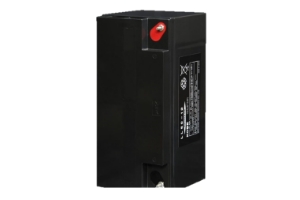
Battery Appearance (Example)
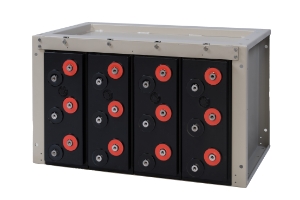
LL1500-WS-8
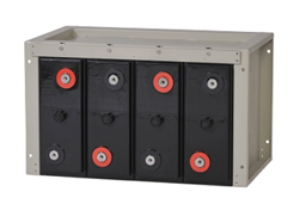
LL1500-8
Battery Assembly External Dimensions (Example)
System configurations can be proposed according to customer requirements.
●Installation example: LL1500-G type, 160 cells in series (The external dimension drawing below is an example; actual system configuration varies depending on the operating environment.)
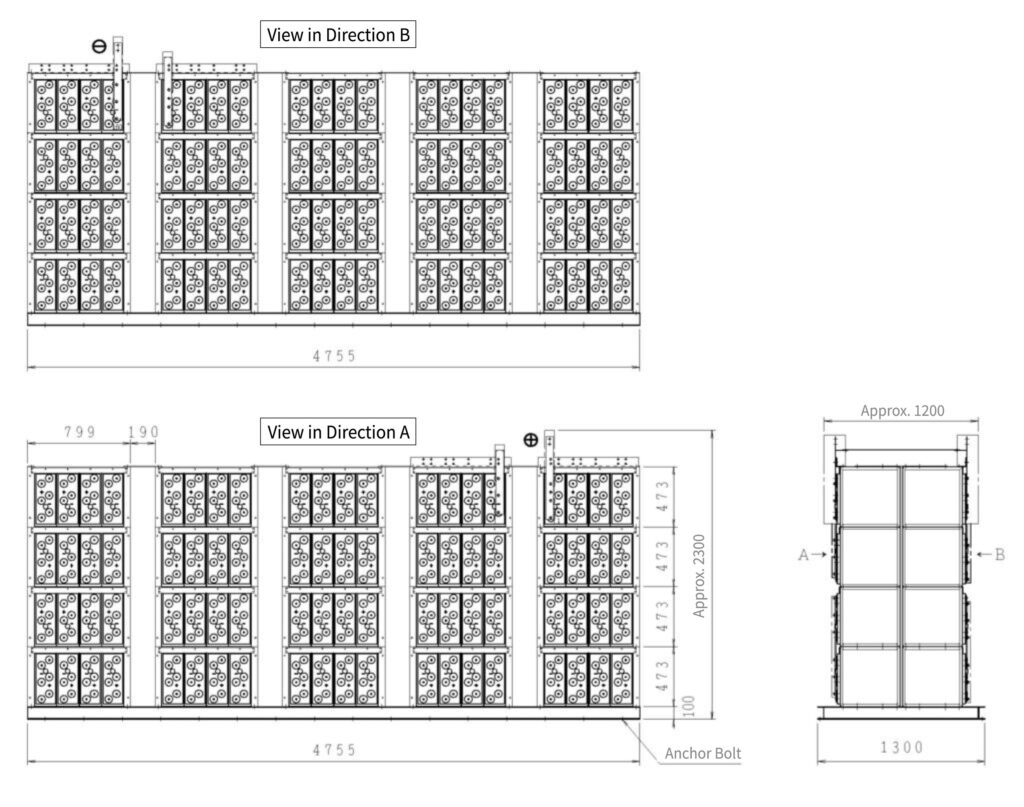
LL50-12 indicates single-cell dimensions.
*² “Expected service life” refers to the design life estimated by Energywith based on tests conducted under specific conditions.
Actual service life varies depending on operating conditions and is not guaranteed.
*³ Expected values derived from tests conducted under the following conditions:
25°C, SOC 30–90%, discharge current 0.1C10A, charge current 0.1C10A, charging under Energywith-specified conditions.
(SOC (State of Charge): An indicator representing the state of charge. Full charge is defined as 100%, and it is calculated based on the cumulative current.)
*⁴ Expected values derived from tests conducted under the following conditions:
25°C, DOD 70%, discharge current 0.175C10A, charging under Energywith-specified conditions.
(DOD (Depth of Discharge): An indicator representing the depth of discharge. Calculated by cumulative current, with a fully charged state set as 0%)
*⁵ Indicates allowable operating temperature range.
Battery characteristics and service life vary depending on temperature.
Related Solutions