
Instruction and safety information for automotive batteries
1. Safety Precautions and Basic Handling Measures
-
 Read the manual
To ensure that the battery is used safely and correctly, make sure to read the precautions in this instruction manual and on the top (lid) of the battery.
Also make sure to read the instruction manual of the vehicle. -
 No open flames
Hydrogen gas may be emitted by the battery. Do not short the positive and negative terminals with a metal tool or use the battery in locations exposed to sparks or flames such as lit cigarettes, locations that are airtight, or locations exposed to water or seawater. Doing so may cause ignition, explosion, burning, damage, or leaking of the battery, and lead to vehicle damage.
-
 Beware of explosion
Before handling the battery, touch a metal object other than the battery (such as the vehicle body) to release any static electricity. Static electricity may cause ignition and explosion due to sparks. After installing the battery, check the cable terminals for loose connections or corrosion. Looseness or corrosion may cause sparks and lead to ignition and explosion.
-
 Beware of sulphuric acid
 Wear goggles
The electrolyte of the battery is dilute sulphuric acid. Avoid tilting or impacting the battery to ensure that the electrolyte does not leak. When handling the battery, wear rubber gloves and protective goggles. If electrolyte enters your eyes, wash them with a large quantity of clean water such as tap water, then swiftly seek medical assistance. Electrolyte may cause blindness. If electrolyte gets in your mouth or is ingested, immediately gargle a large quantity of drinking water several times, drink a large quantity of drinking water, then swiftly seek medical assistance. Electrolyte may cause burns inside your mouth. If electrolyte adheres to your skin or clothing, immediately wash it off with a large quantity of water, and adequately wash the affected area with soap. Electrolyte may cause burns or damage to clothing.
-
 Keep away from children
The battery contains electrolyte. Keep it away from children or others without adequate knowledge of how to handle the battery and its dangers. Electrolyte may cause blindness or burns.
-
 Recycle
The raw materials of a used battery are recyclable. Do not dispose of the battery with household rubbish. Ask the store where the new battery is purchased how you can recycle the old battery.
(1) Usage Environment
Use a battery of an appropriate size and performance rank for the vehicle. Using an inappropriate battery may cause internal damage or bursting (explosion) due to the flow of a large current.
The battery can be used continuously at an ambient temperature of -15° C to 60° C or used for short periods (of two to three hours) at an ambient temperature of -30° C to 75° C. Using or storing the battery outside this temperature range may cause overheating or freezing of the electrolyte and lead to damage or deformation.
(2) Cautions regarding Battery Use
Do not use or charge the battery when the battery electrolyte is at a low level. Also do not use or charge the battery if it emits an abnormal smell during use or if electrolyte decreases at an abnormal rate (if water addition is required around once a month). Doing so may cause bursting (explosion). Hazardous gas may also be emitted.
If electrolyte leaks because the battery was accidentally tilted or damaged, neutralize the battery with a material such as sodium bicarbonate (until the bubbles stop) then wash it with a large quantity of water. Failure to do so may cause corrosion or pollution.
The battery is a heavy object. When carrying the battery, hold its base or the centre of the handle if it has one, and ensure that the battery is not tilted. Do not swing the battery around by its handle. Doing so may cause the handle to become detached and the battery to drop, which can lead to injury.
Do not use the battery if there are any visible problems, such as cracks, fractures, chips, leaks, or abnormal deformation.
Make sure to follow the instructions in this manual when handling a used battery, as it still contains electrical energy.
Do not disassemble, modify, or destroy the battery. Doing so may cause battery leaking or explosion.
When adding water to the battery, use only purified water. Using non-purified water may cause overheating or the emission of hazardous gas due to impurities in the water, and shorten the battery life. If the battery has an indicator (a mechanism for displaying the state of charge and the level of electrolyte), do not add water with the indicator removed.
The battery gradually discharges due to self discharge. If the vehicle will not be used for an extended period, follow the procedure in “3. (2) Removing the Battery” to remove the battery from the vehicle, then store it in a wellventilated indoor location not exposed to open flames. When storing the battery in the vehicle, it is recommended that the cable terminal of the vehicle is disconnected from the negative terminal of the battery.
When replacing or inspecting the battery, turn off the engine, remove the engine key, and turn the switches of lights and other equipment off.
White sediment or white clouding of the electrolyte may be visible in the battery, but this is not a quality problem.
2. Storing the Battery before Vehicle Installation
Handle the battery as follows when storing it.
i. Store the battery in a well-ventilated location not exposed to open flames.
ii. Store the battery in a location not exposed to rain, dew, or direct sunlight, where there is no danger of inundation or flooding.
iii. Store the battery in a location not subject to high temperature or humidity.
iv. Store the battery in a state where it is not on its side or tilted.
v. Store the battery in a location where it will not easily fall down or where other objects will not fall down.
vi. Store the battery in a location not subject to the emission or infiltration of hazardous gas, droplets, or dust.
vii. Store the battery in a location where it will not come in contact with materials such as soft PVC including plasticizer.
The battery gradually discharges due to self discharge. When storing the battery for an extended period, charge it as indicated in 5.(1) before use.
3. Replacing the Battery
(1) Cautions regarding Battery Replacement
When replacing the battery, make sure to follow the instruction manual and service manual of the vehicle.
For vehicles with an exhaust tube connected to the installed battery, a dedicated battery with a structure for collective exhaust is required. Such vehicles require a dedicated battery to be installed or hydrogen gas may fill the vehicle interior and cause an explosion due to external ignition. Hazardous gas may fill the vehicle interior.
*Installing the vent hole cap
If a vent hole cap is included with the battery, properly install the vent hole cap to the vent hole with the exhaust tube and the vent hole on the other side. If a vent hole cap is not included with the battery, remove the vent hole cap attached to the existing battery and install it to the replacement battery, or ask the store where the battery was purchased for help. If an exhaust tube is not connected from the vehicle to the battery, a vent hole cap does not need to be installed.
Select a battery with the positive terminal and negative terminal in the same position. If you install a battery with the terminals in different positions, an abnormal load will be placed on the cable on the vehicle side, and the cable will be damaged.
If two batteries are installed, replace them with two new batteries of the same type. If you install different types of battery or batteries that have been used for different lengths of time in the same vehicle, performance will be imbalanced and the battery life will be shorter.
When installing the cable terminal on the vehicle side to the battery, do not reverse the positive terminal and negative terminal. Also do not use a connection cable that has wear or deterioration.
Do not cover the vent holes of the vent plug of the battery.
Do not directly connect electrical devices to the battery.
Secure the battery with a mounting bracket.
For vehicles containing electronic devices with a memory function, removing the battery may erase the memory, so make sure to read the instruction manual of the vehicle.
(2) Removing the Battery
Disconnect the negative cable terminal first. Then disconnect the positive cable terminal.
Loosen the battery mounting bracket, then remove the battery.
If the cable terminals are corroded, clean them with a wire brush or sandpaper.
(3) Installing the Battery
Install the new battery in the same position as the old battery, and secure the mounting bracket so that the battery does not wobble.
If the battery has a handle, follow the instructions below. If the battery is a B size or D size JIS type battery, remove the handle. The handle may interfere with the mounting bracket. It may also become detached when the vehicle is in motion.
If the battery is an E size, F size, G size, or H size JIS type battery or EN type battery, the handle is designed to not interfere with the mounting bracket or designed to not be removed, so install the battery with the handle attached.
Connect the positive cable terminal first. Then connect the negative cable terminal. Tighten the cable terminals so that they are not loose.
Applying grease to the metal part of the cable terminals is an effective way to prevent corrosion.
If a terminal cover or heat shield was installed, return it after replacing the battery.
4. Battery Inspection and Maintenance
(1) Cautions regarding Battery Inspection and Maintenance
Inspect the level of the battery electrolyte on a regular basis. Inspect it at least once a month.
Clean the battery using a cloth dampened with water. Cleaning it with a dry cloth may generate static electricity.
Do not clean the battery with organic solvents such as benzene, thinner, or gasoline, detergent, or a chemical rag.
Chemicals such as organic solvents may damage the battery and cause leaks.
(2) Battery Inspection and Maintenance Procedure
i. Checking the exterior, mounting bracket, cable terminals, and connection cable Check the exterior, check the mounting bracket and cable terminals for looseness, and check the connection cable for any problems.
ii. Inspecting the electrolyte level and adding water
[Type A] Inspecting the electrolyte level from the side of the battery (when there is a vent plug)
Clean the area around the electrolyte level line with a cloth dampened with water, and confirm that the level of electrolyte is between the upper level line and lower level line. If the electrolyte is closer to the lower level line than the upper level line, add purified water until the upper level line is reached. Do not add too much purified water. If you exceed the upper level line, the electrolyte may leak and damage the vehicle. A type A battery may have an indicator (a mechanism for displaying the state of charge and the level of electrolyte), but the indicator indicates the state of the battery based on a representative cell, so only use it as a guide.
[Type B] When the electrolyte level cannot be inspected from the side of the battery (when there is no vent plug)
The electrolyte level of a type B battery cannot be inspected from the side, so use the indicator for inspection. If the indicator of a type B battery states that the battery needs to be replaced, replace the battery immediately, as water cannot be added. If the indicator cannot be checked, replace the battery or contact the store where the battery was purchased.
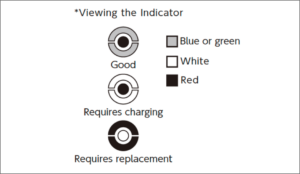
iii. Cleaning the Battery
Clean the battery using a cloth dampened with water. Inspect the vent holes of the vent plug, and if they are clogged with mud or other material, wash the vent plug with water to remove the clogging. Using the battery with the vent holes clogged may cause the internal pressure to rise due to gas emitted from the battery and lead to the battery bursting.
5. Dealing with Battery Discharge
If you forget to turn the vehicle lights off or the vehicle is left unattended for an extended period of time, the battery may discharge and prevent the engine from starting. In this case, charge the battery with a charger. In an emergency, a jumping start can be performed with a rescue vehicle.
Regardless of the above, aim to charge when the battery terminal voltage is 12.5 V or below or the electrolyte specific gravity is 1.240 (at 20° C) or below.
(1) Charging the Battery with a Charger
i. Cautions
When charging the battery with a charger, make sure to follow the instruction manual of the charger.
Avoid charging the battery while it is installed in the vehicle, as doing so may cause ignition and explosion or damage to the vehicle.
Never remove the charging clips while charging.
Before charging the battery, make sure to inspect the electrolyte level as indicated in 4. (2). ii. If the electrolyte level is inappropriate, add water and charge the battery if the battery is a type A battery, or replace the battery without charging if the battery is a type B battery, as water cannot be added. Also check the electrolyte level and perform the required measures after charging.
Make sure that the electrolyte temperature is at 45° C or lower when charging.
When charging, remove the vent plug if it can be removed to make it easier for gas to escape from the battery.
Also ensure there is sufficient ventilation.
ii. Charging Method
Charge the battery by following the proper procedure indicated in the instruction manual included with the charger.
Connect the positive charging clip to the positive terminal of the battery, then the negative charging clip to the negative terminal of the battery. Reversing the order or connecting the terminals backwards may cause ignition and explosion or damage to the vehicle.
Make sure the charge current is lower than 1/10 the battery capacity. Do not charge with a current that exceeds that value.
Charging is complete in 5 to 10 hours, when a large quantity of gas is emitted from the cells of the battery. If you have a voltmeter and density hydrometer, confirm that the terminal voltage is 15.0 V or higher while charging and that the electrolyte specific gravity is 1.270 (at 20° C) or higher.
Tighten the vent plug securely after charging is complete.
(2) Jumping Start with a Rescue Vehicle
The proper procedure must be followed to perform a jumping start with a booster cable connected to a rescue vehicle. Make sure to read the instruction manual of the vehicle. Improper handling procedures may cause ignition and explosion.
Make sure to use a rescue vehicle battery with the same voltage (12 V or 24 V) and performance rank as that of the vehicle.
After starting the engine, swiftly request an inspection at a petrol station, the store where the battery was purchased, or a car dealership.
AKS Building 3 Kanda Neribeicho, Chiyoda-ku, Tokyo 101-0022, Japan
https://www. energy-with. com/en/